
A few weeks ago, I stood in front of my wardrobe for twenty minutes trying to find something—anything—I actually wanted to wear.
Hangers were packed so tightly I could barely slide them, and yet nothing felt right. That’s when I realized I wasn’t out of options; I was overwhelmed by too many.
For those of us who take pride in a tidy, peaceful home, a messy closet can quietly undo the calm we’ve worked so hard to create. It becomes a daily source of frustration, even anxiety—one that sneaks into our mornings and steals our time and energy.
If you’re ready to reclaim your space and simplify your routine, these 17 wardrobe decluttering tips will help you cut through the clutter, find what you truly love, and bring a little more clarity and calm to your day, starting right where you get dressed.
Start Small and Sort as You Go
You don’t need a free Saturday to make progress. Work through one clothing category at a time — tops one evening, shoes the next. As you pull items out, create four piles: keep, donate, sell, and recycle.
A fifth “maybe” pile works well for borderline items. Box them up, set a reminder for three months, and revisit. If you haven’t thought about them, let them go.
Once you finish a session, act on it the same day. Drop donations at a thrift store. Take worn-out pieces to a textile recycling bin. List items for sale within a week, and if they don’t move, donate those too.
Run each piece through these questions before deciding:
Questions Worth Asking Before You Keep Anything
- Does it fit my body right now?
- Do I feel good wearing it?
- Is it in solid condition?
- When did I last actually wear it?
- How many similar items do I already own?
- Is it practical for my day-to-day life?
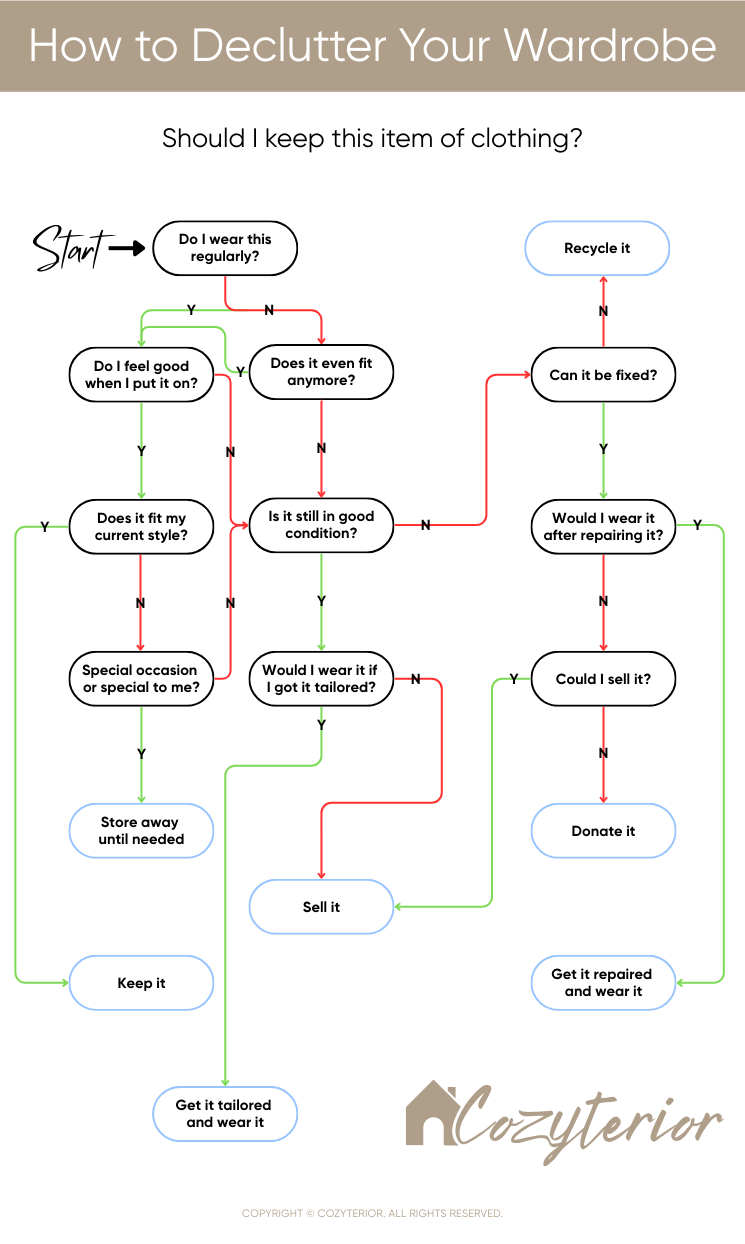
I put together this handy flow chart to take the guesswork out of decluttering — just follow the steps, and it’ll tell you exactly what to do with each piece.
17 Things to Remove From Your Closet
1. Clothes that irritate you while you wear them
A few years ago, I held onto a beautiful silk blouse for the better part of a year. The color was perfect, the cut was elegant, but the fabric made my skin crawl by mid-morning.
I kept thinking I’d get used to it, but I never did. That’s the thing about clothes that irritate you — the annoyance doesn’t fade with time, it compounds.
Whether it’s underwear that rides up, a waistband that digs in, or a sweater that scratches your neck all day, no garment is worth that kind of constant distraction. If you have to think about what you’re wearing while you’re wearing it, that’s reason enough to let it go.
2. Pieces you try on and immediately take off
I used to have a pair of wide-leg trousers that I was convinced I’d eventually “figure out.” Every few weeks, I’d pull them on, study myself in the mirror, and change into something else before leaving the bedroom.
Sound familiar? That cycle of trying and rejecting burns time and quietly erodes your confidence before the day has even started. If a piece consistently gets swapped out, your instincts are telling you something worth listening to.
3. Worn-out and damaged clothing
There’s a particular kind of denial that happens with damaged clothes. You keep the jeans with the fraying hem because they still technically fit.
You hold onto the coat with the broken zipper because it was expensive. I kept a favorite cashmere sweater long after it had pilled beyond saving because letting it go felt like admitting it was really over.
But worn-out clothes don’t serve you — they just remind you of better days. Stained shirts, bras with poking wires, tights with runs — take them to a textile recycling bin and make peace with it.
4. Clothes that make you feel self-conscious
A good friend once told me she owned a dress she described as “aspirational.” She never wore it because it showed her arms, and showing her arms made her uncomfortable.
It hung in her closet for three years, quietly making her feel bad every time she spotted it. Clothes that highlight something you’re not at ease with have no business taking up space in your wardrobe. Getting dressed should set you up for the day, not chip away at how you feel before you’ve even left the house.
5. Anything that doesn’t fit your current body
Bodies change — after pregnancies, after illnesses, after years of simply living differently. I’ve held onto jeans from a decade ago that I genuinely believed I’d fit back into someday.
What I didn’t realize at the time was how much that “someday” pile was quietly weighing on me every time I opened the wardrobe.
Clothes that are too tight carry their own kind of pressure, and clothes that are too loose can anchor you to a version of yourself that no longer exists. Keep what fits the body you have right now.
6. High-maintenance items you never bother with
Early in my career, I bought a beautiful tailored blazer that required dry cleaning after every few wears. I loved it on the hanger.
In practice, I avoided wearing it because the upkeep felt like too much effort on a busy week. It sat unworn for most of a year before I finally admitted the truth: if the care instructions make you hesitant to reach for something, you’re never going to reach for it.
Be honest about the kind of wardrobe maintenance you’re actually willing to do, and edit your closet to match that reality.
7. Clothes from a different chapter of your life
When I left a corporate job to work independently, I kept a wardrobe full of formal work attire for almost 2 years. I told myself I might need them again, but sadly, I didn’t.
Meanwhile, they took up half my closet, and I had to reach past them every day to get to the clothes I actually wore.
Maternity wear after you’re done having children, cocktail dresses from a more social season of life, uniforms from a job you no longer hold, these pieces belong to chapters that have already closed. Pass them on to someone living that chapter now.
8. Items still wearing their tags
We’ve all done it. Bought something on impulse, or during a sale, or because it seemed like a good idea at the time, and then never wore it.
I once found a linen shirt at the back of my closet with the tag still on, bought so long ago I couldn’t even remember the occasion.
The financial guilt around these pieces is real, but keeping them doesn’t recover the money spent. Resell them, donate them, and let go of the idea that holding onto them makes the purchase more justified.
9. Pieces that only work with one outfit
A few years ago, I bought a pair of statement shoes in a very specific shade of burnt orange. They were striking. They also worked with exactly one outfit in my entire wardrobe. I wore them twice before the novelty wore off, and they spent the next two years occupying prime shelf space.
Unless a highly specific piece gets regular use, the space it takes up rarely justifies its presence. Think carefully before holding onto anything that demands the rest of your wardrobe to accommodate it.
10. Shoes that hurt your feet
I once wore a pair of heels to a work event and spent the entire evening calculating how long it would be before I could sit down.
I wore them exactly twice before accepting that no shoe is worth that level of strategic suffering. Shoes that cause blisters, pinch your toes, or leave you limping tend to get pushed to the back of the rack and stay there. Your feet carry you through the day, so they deserve better than shoes you avoid wearing.
11. Things that no longer reflect your taste
Taste is not fixed. What felt fresh and exciting at 25 can feel completely wrong at 35, and that’s just growth. I spent years holding onto a collection of graphic tees I’d loved in my twenties because letting them go felt like erasing that part of my history.
Eventually, I realized I was keeping clothes for nostalgia rather than because I wanted to wear them. If a piece no longer feels like you, trust that instinct. Someone else will get far more use out of it.
12. Anything unworn for the past 12 months
A full year is a generous window. It covers every season, most occasions, and the full range of your daily moods. If something didn’t get worn in that time, it’s worth asking why.
I used to make excuses: the weather wasn’t right, the occasion hadn’t come up, I was waiting for the right moment. But the right moment rarely comes for clothes we’ve already started avoiding.
Sentimental pieces like wedding outfits or prom dresses are a separate conversation; photograph them if you need to preserve the memory, but don’t feel obligated to store them forever.
13. Items missing their partner
The optimistic approach to lone socks is to keep them in a drawer for weeks, hoping the missing one will turn up in the next laundry load. I did this for years with a growing pile of single socks that never found their matches.
The same applies to earrings without a pair, shoes where one has been lost or ruined, and anything that relies on another piece you no longer own. Give yourself a reasonable window to find the match, and then let it go.
14. Tarnished or broken jewelry
A jewelry box full of tangled chains, broken clasps, and rings that leave green marks on your fingers is surprisingly draining to look at.
I inherited a habit of keeping broken jewelry “just in case” I found someone to fix it, and for years, I never did. If a piece is genuinely worth repairing, book that appointment now.
If it’s been sitting damaged for longer than you can remember, recycle it and free up space for pieces you actually use.
15. Accessories you never reach for
Accessories have a way of multiplying without you noticing. Scarves from gift exchanges, belts bought to complete an outfit you no longer own, handbags that seemed essential at the time, they pile up fast.
I once counted eleven scarves in my wardrobe and realized I regularly wore two of them. The rest were just taking up drawer space.
If you’re not reaching for something season after season, it’s not earning its place. Higher-value items, such as leather bags or quality jewelry, are worth listing for resale before donating.
16. Clothes waiting to be mended
Most of us have a small pile of clothes that need a button replaced, a hem taken up, or a seam resewn. The pile tends to sit in the corner of the closet, growing slowly and generating a low hum of guilt every time you notice it.
I kept a pair of trousers in that pile for over a year before finally taking them to a tailor, and it took twenty minutes and cost very little.
If the repair is straightforward, schedule it and actually follow through. If you know in your gut you’ll never get around to it, put the piece in a recycling bin and move on.
17. Duplicates and excess in any category
At one point, I owned nine striped tops. Nine. I told myself each one was slightly different, which was technically true and also completely beside the point.
Having too many options in any single category doesn’t really expand your wardrobe, it just makes it harder to get dressed.
Go through each category with fresh eyes, keep the pieces that genuinely earn their place, and part with the rest. A smaller selection of things you actually love will serve you far better than a crowded rail of things you sort of like.